Exterior Nature & Birds
S spotSpace replayEsc stop←→ selectP pin · drag a tile onto the Pegboarddrag a tile into any editor · file goes with it

A visual kit for the sounds you use most. Every effect is a picture on a tile, not a filename in a list. Hunt by eye, audition on press, and land it in the session from the SPOT lip. Spot to Pro Tools. Drag anywhere else.
You already know which sound it is and which track it belongs on. Everything Pegbox does is remove the steps between those two facts.
About 9 ms from the press, at a matched level against every other bed in the kit. You are comparing sound to sound, not level to level, and nothing has to load first.
At the insertion point, named, at the level you just heard. No import dialog, no folder to choose. Pro Tools today.
The sounds this show never stops asking for go on the pegboard. Drag them up, they stay there. One show ends, you clear the board and hang the next one.
Every sound is a tile with its own image, in color-coded categories you build. No more reading UCS filenames to find the door you used Wednesday.
Assign a destination track per sound or per category. Spot ignores whatever happens to be selected in the session.
Record starts playback in Pro Tools. Spot stops playback and commits the file at the insert point. No track arm. No MIDI map.
This is the Workspace as it looks on the Mac, loaded with a slice of a real library: the same sidebar, the same tiles and pictures, the same one-key spot. Categories bind to Pro Tools tracks, so a gun lands on the gun track. Pin what a project keeps reaching for onto the Pegboard.
Foley artists who record on their own stage and cut the track in Pro Tools: hang the takes you reuse, hunt them by picture, play the ones that have to hit, and spot them onto the FS, PROP and CLTH tracks you already deliver. The mixer gets a built Foley track. You stop digging through take_14b.
Drop a recording and Pegbox slices it at every hit. This panel is the real thing: your Keyboards and Cameras kits, sliced live in the browser from the original recordings. Drag the level line to keep only the strong hits. Play from the keyboard, a MIDI controller or the iPad, record the performance, and spot the take. The button that ends the pass is the one that commits it.
For the sounds that have to hit picture: footsteps, cloth, props, typing, a phone grab, a fight. Record them once on your own stage, then play the sounds to the scene in Pegbox — take after take, no re-recording.
Hitting record in Pegbox starts playback in the session. Picture runs.
Computer keyboard, a MIDI controller, the iPad, or the mouse. Whatever is in your hand.
The same key that ends the pass is the one that commits it. One gesture, not two.
At the insertion point, on the track you assigned — FS, PROP, CLTH, whatever you deliver. The same session you hand the mixer. No record arm, no input routing, no MIDI map.
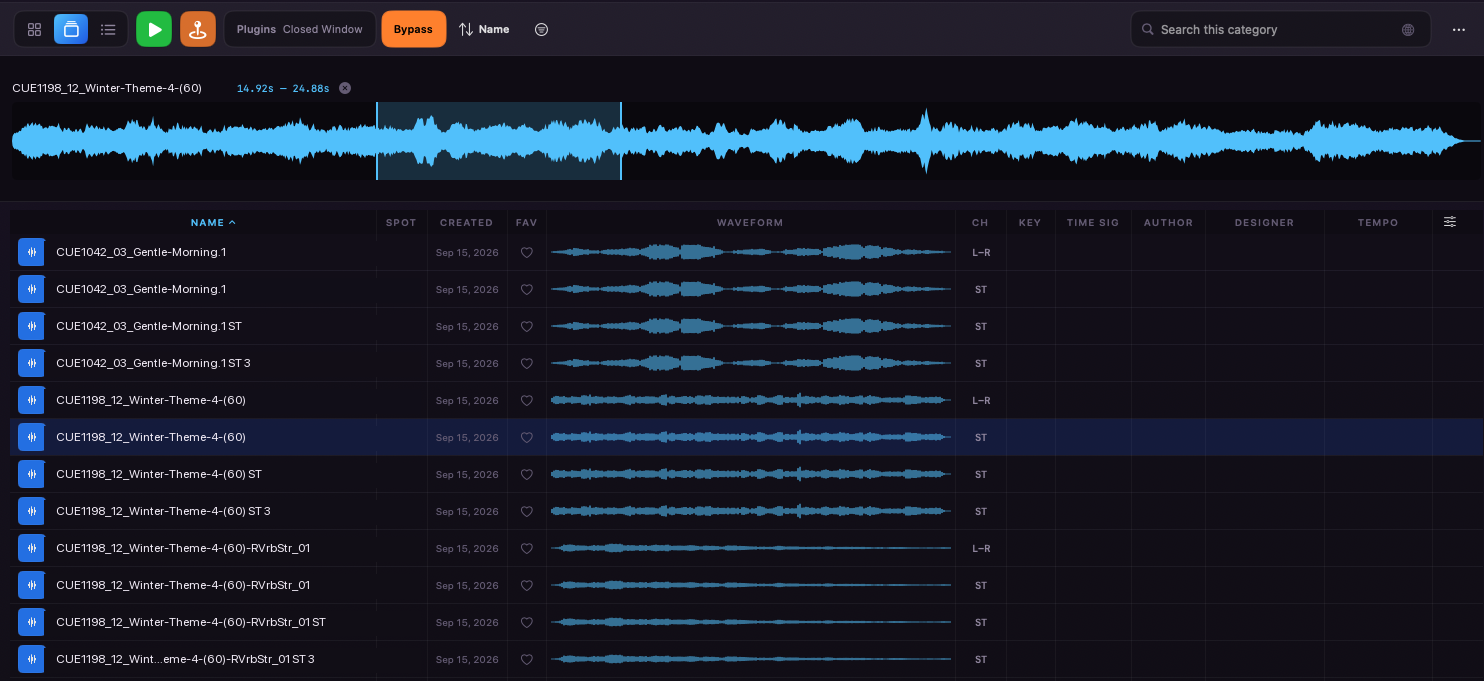
A theme, a whoosh sting, an outro — still sounds, but a three-minute cue doesn't fit on a picture tile. Stacks is the list view built for exactly that: every cue with its full waveform, right there to scan. Click into it to find the hook or the downbeat, then SPOT lands that exact moment at the cursor — same lip, same one gesture. Key, tempo, time signature and who scored it sit in the row, because those are the questions a music editor actually asks.
Filenames are precise and unreadable. Pegbox turns each one into a picture. It ships with a photo album of pictures and icons already drawn for the things a show asks for over and over: doors, rooms, cars, phones, footsteps, weapons. Pick one and the tile is done. Every picture below is a real tile from this library.
When the album does not have the door you mean, draw your own. Illustrate a whole category automatically from the filename and embedded metadata, or write a prompt for one tile, with your own OpenAI or Gemini key: about a dollar per 200 tiles with OpenAI, about eight with Gemini. No key and the photo album still covers the board.
Prompts built from filename + BWF description · six tiles cost $0.03 with OpenAI gpt-image-1-mini at low quality ($0.005 each) or $0.23 with Gemini 2.5 Flash Image ($0.039 each). The app shows the price and asks before it spends.
A Pegbox library is a set of references to your originals: the drive, the folder, the name they already have. Nothing is duplicated, renamed, or moved into a database. Point a category at a folder and it keeps itself in sync as you add and rename files. Unplug the drive and tiles go amber, not missing.
Pegbox is not Soundly, SoundQ or Soundminer. Keep those for discovery. Pegbox is the tray you reach for after a sound has already earned its place in the show.
Each lives in its own tab, uses your own ElevenLabs key, and delivers 48 kHz / 24-bit WAV you can drag onto a track or spot with one click.
Describe the sound, get up to four takes as they land. Duration, influence and seamless loop controls.
Type it, speak it, or re-voice a reference file. One-click delivery tags drop straight into the script.
Drop a noisy dialogue file, get the clean vocal back, conformed and ready to spot.
Speaker-labelled transcripts with a synced player. Point a watch folder at your bounces and every new file transcribes itself.
Bring your own keys. ElevenLabs, OpenAI and Gemini keys live in the macOS Keychain and talk to those services directly. Pegbox has no backend, no markup and no account of its own.